
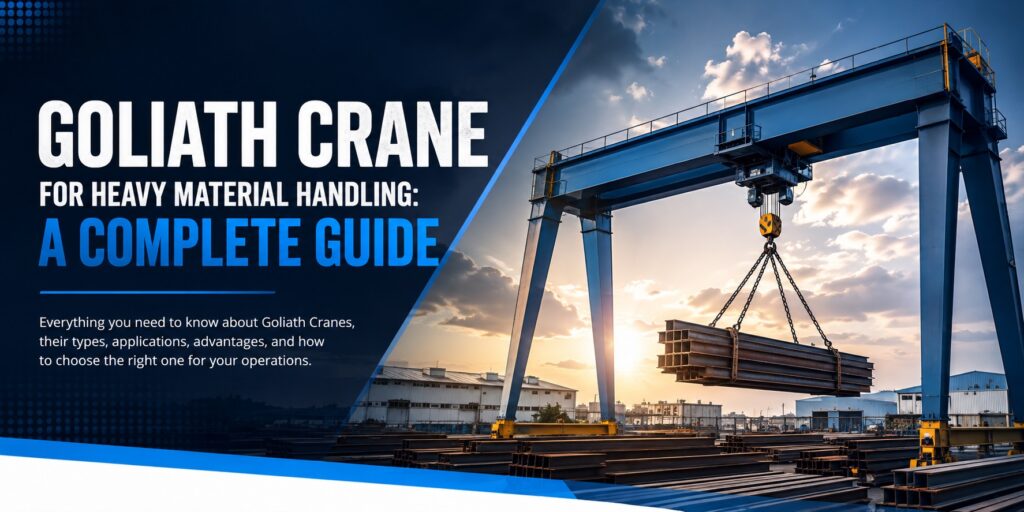
Shipyards and construction sites often deal with heavy materials. Here, heavy-duty material handling and lifting equipment are the backbone of major operations. These cranes are Goliath cranes, built to handle massive loads with precise aim. As India emerges as a global power, the role of these cranes is becoming crucial in supporting heavy industrial work. Millions of metric tonnes of steel are produced annually, and the automotive sector continues to grow with a higher number of vehicles every year. Hence, the heavy industrial business needs to partner with top goliath crane manufacturers.
Goliath Crane Explained
Goliath crane is used in industries for heavy lifting and moving bulky structures or objects. It has a horizontal girder that is supported by two movable legs. Unlike overhead cranes, these are open cranes that do not need overhead building support. It consists of end carriages, a lifting trolley or crab, cantilever extensions and ground-level rail systems. To understand the application of this crane, imagine the prefabricated steel roofing sheets being installed along the purlins of a metal building. Because the bundles of sheets can be too heavy to be lifted using manual effort or medium-capacity machines, the goliath cranes lift and place them securely onto the building.
How Goliath Cranes Handle Heavy Materials
Controlled Lifting and Movement
The hoisting mechanism elevates or lowers the cargo, while the trolley transports it across the beam. The whole trolley can move on its own runway. Such an organized action allows workers to maneuver the steel members, devices, building elements, concrete parts, and other weighty materials more efficiently.
Stable Support Structure
The crane’s legs transmit all the loads contained in the structure through the end carriages and wheels to the rails grounded on the ground. With this design, overhead installation of the crane is also possible.
Why Choose the Right Manufacturer?
A goliath crane is an engineering lifting device, and the actual suitability is much more than just lifting capacity. The major components, such as the main beam, pillars, hoist, trolley, wheels, drive systems, controllers and safety devices, need to work together according to the application. Experienced goliath crane manufacturers consider aspects like load capacity, frequency of operation, length of the span, lift height, and site conditions before establishing crane design. Good engineering at this stage increases operational reliability and minimizes restrictions during normal operation.
Key Factors When Selecting a Goliath Crane
Lifting Capacity
The capacity rating should match the maximum load the crane is required to lift. Before choosing a crane, the substance and size of the load, as well as its lifting frequency, should be taken into consideration.
Span and Lifting Height
Span indicates the breadth of the area that can be worked on with the help of a crane, while lifting height shows how high the load can be lifted.
Duty Cycle
Cycle of operations refers to the efficiency and intensity of the crane’s operations. The crane that is used daily will obviously be subject to more requirements than the one that works occasionally.
Applications of Goliath Cranes
Goliath cranes are used in large and open spaces to lift and move heavy loads. The practical applications are:
- Shipyards
- Construction sites
- Steel plants
- Fabrication yards
- Industrial storage yards
Conclusion
Goliath cranes are an effective option for the management of heavy materials in sectors that require lifting and moving of bulky loads. As their construction involves being seated on the ground, goliath cranes are strong and highly effective in accomplishing challenging industrial tasks. By partnering with established goliath crane manufacturers, industries get appropriate cranes for material handling activities for particular requirements and site conditions. Pioneer Cranes is the leading supplier of goliath cranes for various heavy-duty industrial lifting work.